I’ve been using this now for a bit, and now that I’ve not made any
changes to it in a few months, and after a failed pitch at selling it
to a publisher, I’ve decided to release this into the wild. I figure
it’s useful to me and at least one other person, it may be useful to
others.
The essence of it is that instead of the usual tome of a chord
dictionary that most are, this one plots the chord tones across 17
frets of a guitar neck, using note numbers instead of names. This
way, you don’t have 12 versions of a minor 9th chord, but only one.
Amongst other things, this and the included index can help you find
voicings, or good substutions for chords. In any case, printed double
sided, the thing runs about eighteen pages, slim enough to keep in a
music binder or folder you might use during practices or performances.
Back at the end of December, I posted 17 Frets Chords, a concise
chord dictionary. I had been working on a scale encyclopedia too,
but hadn’t put the finishing touches on it.
It’s mostly where I want it, but there are some places where it’s
not as good as I want, but I figure, might as well release it now.
17 Frets Scales shows the major scale families and their modes, in
addition to including available chords for most scales. Like 17 Frets
Chords, it’s also indexed by intervals, notes, chord names, scale/mode
names and their aliases, which should help you identify the scale
you’re looking for.
Since it’s related to my day job, it’s over on
Medium.
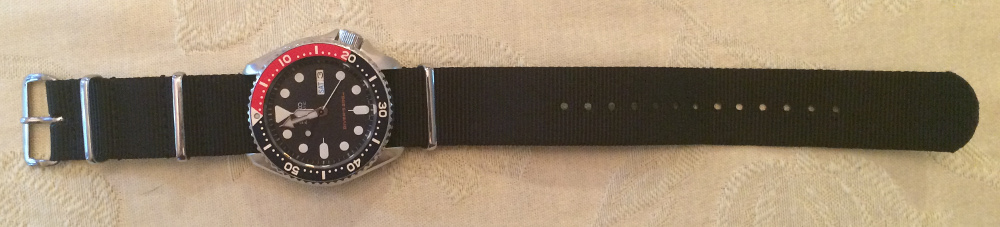
For Christmas last year, my wife bought me a Seiko SKX-009 which I
absolutely love. Even though I love it, I looked at a bunch of higher
end Swiss watches but found that even though many of them look really
great (I came pretty close to buying an Omega Seamaster Planet Ocean
Chrono), but realized that when it came to the features I use on the
SKX, the number of Swiss watches that actually fulfil them is very
few. Like the Fortis Marine Master and Cosmonaut were the only two I
could find - but while they fit what I want, I don’t care so much for
the styling. But the accuracy of a Swiss watch was appealing as the
SKX had settled to losing 15 seconds a day, which isn’t wonderful.
But at least it was a very consistent 15 s/d.
I’ve been interested in timekeeping devices for many years, and have
generally been facinated with watches, and in the last year or so,
I’ve become I big fan of mechanical ones.
I’ve been particularly interested in the Seiko automatics. I’ve not
seen a better quality automatic watch anywhere in the price range,
both in terms of the movement, and the case. The Seiko movements have
proven, for the two of them that I’ve owned, to be very reliable and
satisfyingly accurate.
N.B. Some of this revolves around puppet, but if you know nothing
about puppet, you won’t miss anything.
I’ve been doing a bunch of stuff in puppet lately. Since my actual
puppet runs are inside VMs which I nuke fairly frequently, doing the
actual bits of development in the VM is impractical (and somewhat
dangerous even).
I use git to do my normal version control anyway, so that’s nothing
earth shattering, but I also use git to update /etc/puppet in
the VM from what’s on my laptop because it works really well.
It’s funny sometimes how when you’ve done something in a particular
way for long enough, it’s easy to forget why you do it the way you do.
I’ve been a big fan of early return for a long time and was recently
challenged on my view. The argument I had received in favor of single
return was dubious to me, but it’s always good to recheck why you do
something when you’ve forgotten.
It’s been close to a year since I started my shorthand quest in
earnest.
I did wind up changing systems from Gregg Anniversary Edition to
Gregg Shorthand Simplified
as I found it better for those, like me, who don’t have an in person teacher.
Speed-wise, last I checked I was at something better than 70wpm. I’m
probably a bit faster since then which is over six months ago, but
either way I’m sufficiently fast for my needs – well above the
30-35wpm longhand I could ever manage. I do at least weekly practice
by taking notes during church and I can still read them long after the
sermon. While I did switch away from Anniversary Gregg, the
Anniversary edition dictionary is still quite useful to have as the
forms haven’t changed that much for the rare time I do need to look
things up.
When designing storage systems for applications, not building
something like a SQL/NoSQL database, I’m talking the layer/logic that
goes on top, you have to consider a whole bunch of things if you want
to build the “right thing(TM)” for your application.
In part one, we’ll be considering the simple cases (spoiler: most
cases are simple) and SQL databases, in part 2 we’ll be
considering NoSQL databases.
Even with various considerations to think about, hard and fast rules
about datastores tend to get very difficult, as the various
considerations can push things around quite a bit as to how to best
implement them for today while taking tomorrow into account.
Somewhat written to future-me, but also
to others who may be looking in the direction of these things.
General Software
If I ever need to deal with LDAP in any way, this tool will make me
have a happy.
For dealing with Java Keystores. The commandline tool supplied with
Java kinda sucks, this makes it easier, especially for things like
x509v3 extensions which you need to twiddle if you ever do CA work.